
“The necklace. The fire. The fifteen years of silence that turned a mother’s grief into a man’s inheritance.”
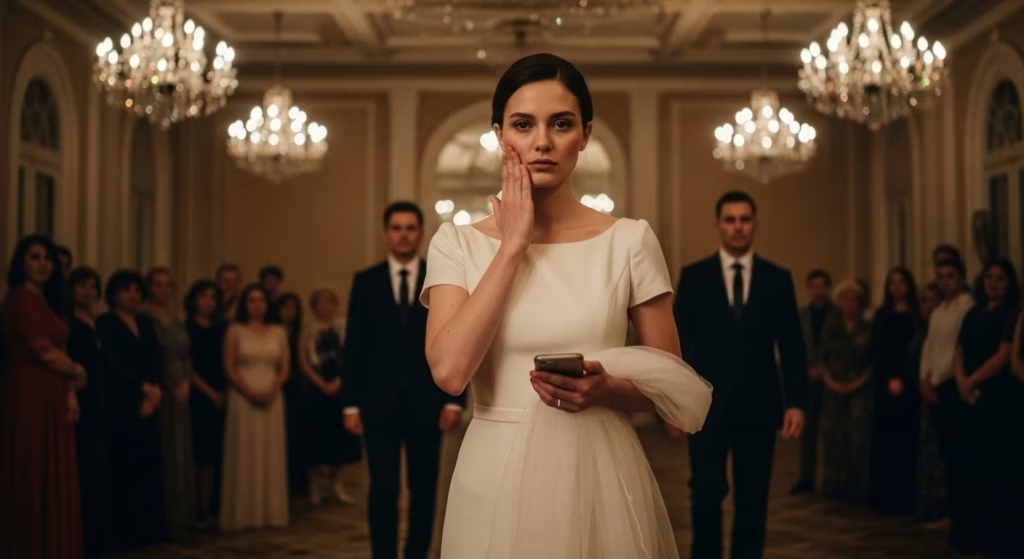
The ballroom was the kind of place that rewarded stillness. Chandeliers dripped light onto champagne flutes and the careful smiles of people who had learned, long ago, that beauty was its own form of armor.
Evelyn Morgan wore hers well. Sixty-two years had given her posture a quality that younger women sometimes mistook for coldness—the straight spine, the practiced smile, the way she held her glass as if she’d been born doing it. She had, in a sense. The Morgan name demanded it. And so did Victor.
She was watching the string quartet when she saw the girl.
A waitress, weaving through the crowd with a tray of canapés, unremarkable in every way except for the thing at her throat. Small. Diamond petals arranged around a center stone. A flower, exactly the size of a child’s fist.
The champagne glass slipped.
She didn’t register the sound of it shattering. She didn’t register the guests who turned, or the quick hand of a server who moved to clean it up. She moved through them the way you move through water in a dream—toward something, unable to stop.
“Excuse me,” she said.
The girl turned. Mid-twenties, dark hair pulled back, a small crease of apology already forming on her brow. “I’m so sorry—did I—”
“Your necklace.” Evelyn’s voice had abandoned her. What came out was barely sound. “May I see it?”
The girl touched it reflexively, a protective gesture. “I didn’t steal it.” The words came quickly, the practiced defense of someone who’d had to justify herself before. “I’ve had it since I was a child. It was given to me.”
Evelyn wasn’t listening to the words so much as watching her face—the particular way her chin lifted, the color of her eyes, the small white scar just above her right eyebrow, thin as a thread. Evelyn had kissed that scar a hundred times. She’d made up a story about it involving a brave princess and a kitten. She’d forgotten the details over the years. She’d forgotten so many things, and then spent a decade trying to remember them all.
Her hand shook as she lifted the pendant and turned it over.
R.M.
The engraving was faint with age, but she would have found it underwater, in the dark, with her eyes closed.
“Rosemary,” she said.
The girl went very still.
“My foster mother called me that.” Her voice was careful. “I haven’t heard it in years.”
Evelyn looked up at her. For a long moment neither of them moved, suspended in something that hadn’t been named yet—something that required more courage than either of them felt, standing in the middle of a ballroom with champagne on the floor and two hundred witnesses.
“I gave that to you,” Evelyn said, “on your third birthday.”
· · ·
She heard Victor before she saw him.
The grip on her arm was familiar—the pressure just firm enough to be a message, not firm enough to be obvious. He had a talent for that. He’d spent thirty years developing it.
“You’re making a scene,” he said softly, smiling at no one in particular. “Come with me.”
She didn’t move.
“She was never supposed to survive the fire.”
She didn’t know, afterward, whether he’d said it loudly or whether the room had simply gone quiet at the right moment. She didn’t know whether he’d meant to say it at all. Victor had always been precise—it was his one genuinely admirable quality—and the words had the sound of something that had slipped, a stone dislodged after years of careful weight pressing it down.
The girl—Rosemary—looked between them.
“What is happening?” she asked. Her voice was calm in the way people are calm when they know that if they stop being calm, something will break that cannot be put back together.
Victor laughed. It was almost convincing. “Your daughter died fifteen years ago, Evelyn. Everyone in this room knows that.”
“Everyone knows what you told them,” Evelyn said.
She had thought about this moment, in the way you think about things you never actually expect to happen—not as a plan, but as a fantasy you return to when the grief becomes unbearable. She had imagined she would be afraid. She had imagined she would falter. Instead she felt something clarify inside her, the way water clarifies when the silt finally settles.
“I was found near a hospital,” Rosemary said quietly. She was speaking to both of them now, her eyes moving between their faces as if reading two different versions of the same story. “They said I had no family. No records. Just this.”
She touched the necklace.
“You had a rabbit,” Evelyn said, and her voice broke on the word in a way she hadn’t expected. “A stuffed one, gray, with a missing eye. You called him Button. I looked for Button too, when I was looking for you. I thought—I don’t know what I thought. That he might lead me somewhere.”
Something crossed Rosemary’s face. Not recognition exactly. More like the sensation of recognizing the shape of a word you’ve never been taught—the feeling that it was always in you, waiting.
· · ·
The detective was named Harris. He had been at the edge of the room for longer than anyone realized, which was, Evelyn understood later, the point.
He stepped forward when Victor called for security, and the way the room made space for him suggested that the room, too, had been waiting.
“We reopened the case last year,” he said. He addressed the room as much as Victor, which seemed deliberate—a choice to make this public, to make it permanent. “There were inconsistencies. Reports that had been filed and then lost. A witness whose statement changed twice.” He paused. “We know why, now.”
Victor’s composure was a remarkable thing to watch dissolve. It went in stages—the jaw first, then the eyes, then the hands, which he had always kept so controlled. “You have nothing,” he said.
“We have enough.”
Later, what Evelyn would remember most was not the moment the officers led him out, not his voice cracking as he shouted things that confirmed everything and helped nothing—she was supposed to be gone, it was all supposed to be mine—but the silence after the doors closed.
It was the first silence in fifteen years that didn’t feel like absence.
· · ·
Rosemary’s hands were steady when Evelyn took them. Steadier than Evelyn’s own.
They stood apart still, a careful distance, two people on either side of a river that had been fifteen years in the making—time they could not compress, losses they could not undo, a childhood that had happened in the wrong house, the wrong name, the wrong life.
“I never stopped looking,” Evelyn said. “Every city. Every year. I had—” She stopped. “I had a file. I updated it every time I thought I had something. I don’t know why I’m telling you that.”
“Because you want me to know it was real,” Rosemary said.
Evelyn looked at her. “Yes.”
Rosemary was quiet for a moment. Around them the room was still—guests who had arrived expecting an evening of small talk and canapés, standing now in the presence of something they hadn’t come prepared for.
“I always felt like something was missing,” Rosemary said finally. “Not in a dramatic way. Just—like there was a question I couldn’t remember asking.” She paused. “I don’t know how to do this.”
“Neither do I,” Evelyn said. “I’ve thought about it for fifteen years and I still don’t know.”
It wasn’t the right thing to say. It was also, perhaps, the only true thing. And something in Rosemary’s face shifted when she heard it—not softened exactly, but opened. The way a room opens when you raise the window.
Evelyn held out her hand.
Rosemary looked at it for a long moment.
Then she took it.
Outside, through the tall windows, the city went on about its business, indifferent and necessary. Inside, the music hadn’t started again, and no one seemed to mind. Some silences are not waiting to be filled.
Some silences are the thing itself.