“The cruelest thing a person can do to another is not to hate them, but to look through them as though they were glass.”
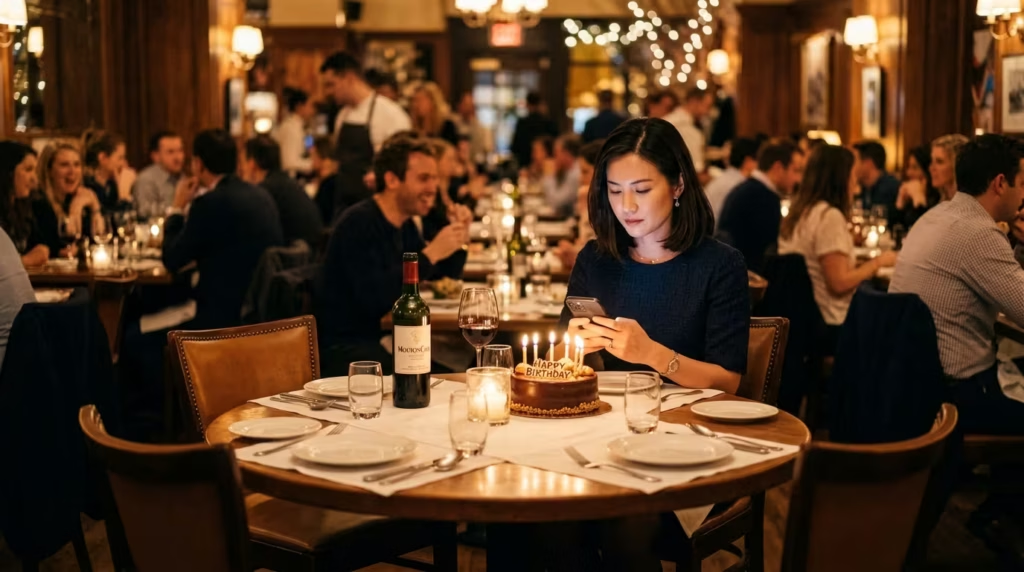
The cake arrived with five candles and no one to watch her blow them out.
Farrah had reserved the corner table two weeks in advance — the good one, near the window where the city lights softened into something almost romantic. She’d asked for the chocolate torte because her mother had always said it was too indulgent, and tonight she wanted to be indulgent. She wanted, more than anything, to sit across from people who loved her and tell them what she had built.
The waiter who lit the candles the first time did not look at her. He had the practiced neutrality of someone who had learned not to notice things. She thanked him anyway and straightened the silverware that didn’t need straightening, and checked her phone again — though she already knew.
No messages. No calls.
She had sent the invitation in the family group chat three weeks ago: Thursday. 7 PM. Dinner’s on me. Big news. And then, when the thread stayed quiet, she’d sent a second message four days later — gentler this time, almost apologetic, as though she were the one who had done something wrong. Her brother Ryan had reacted with a thumbs-up. Her mother had sent a heart. Her father had not replied at all, which was simply how her father communicated — through omission, through the vast and cultivated silence of a man who believed his presence in a room was sufficient love.
She had told herself they would come anyway. She had believed it, truly, in the specific way you believe things that are already contradicted by the evidence, because believing them is easier than the alternative.
This was not new. This was the shape her entire life had taken.
When she graduated college — first in her family to do so — her parents had been four hundred miles away watching Ryan take third place in a regional racing competition. She’d walked across the stage and looked out at the rows of families and felt something close to weightlessness, though not the good kind. Later that year she co-signed an $18,000 motorcycle loan for her brother, because he’d asked and she’d said yes before she finished thinking, and because that was the role she had always occupied in the family — the responsible one, the quiet one, the one who handled things without being asked to handle them. When he stopped making payments two months later, she covered them herself rather than let her credit suffer. No one mentioned it. No one asked her why she was so quiet at Christmas.
When she founded Verdant Alchemy, she told her mother over the phone. Her mother said, That sounds nice, honey and asked whether Ryan had called yet about the boat.
So the empty chairs should not have surprised her. She knew that. She sat with the flickering candles and her untouched wine and let herself feel it completely — not the anger, which would come later and was entitled to, but the loneliness underneath it, which was older and more patient and had been waiting for exactly this moment to sit down across from her.
“Excuse me.”
She looked up.
A man in his early fifties stood at the edge of her table. Silver-haired, soft around the eyes, tortoiseshell glasses that made him look like someone who read serious books and meant it. He was holding his own glass of wine and had the particular posture of someone accustomed to noticing things other people walked past.
“I don’t mean to intrude,” he said. “But I noticed the cake. And the chairs.” He paused, and in the pause there was nothing awkward, which was itself unusual. “No one should have to blow out birthday candles by themselves.”
Farrah opened her mouth to say she was fine, that she was waiting for someone, that she preferred her own company — any of the things she had said a hundred times before in a hundred different rooms. What came out instead was: “No. I suppose they shouldn’t.”
He sat down. He said his name was Alexander Grant. He asked about her life, which was something people rarely did — most people asked about Ryan, or her parents, or whether she’d heard from anyone back home. Alexander asked what she was celebrating and then listened to the answer the way people listen when they are actually curious rather than performing curiosity. When she told him about the investment, about the three years building Verdant Alchemy from a kitchen experiment into something real, something that had just secured $1.2 million and might actually become the thing she believed it could become — he leaned forward and said, You built that from scratch?
Yes.
He raised his glass.
“Happy birthday, Farrah. Tonight should have been your family celebrating you.”
She blew out the candles. The smoke rose and dispersed and the restaurant continued around them — silverware, laughter, the low music none of them had chosen. She felt something release in her chest. Not happiness, exactly. Not peace. Something closer to honesty.
· · ·
Three years moved through her like weather. The company grew the way she had always privately believed it might, which didn’t make it less startling — it only made the disbelief sharper, the kind that comes from being genuinely prepared to fail. Verdant Alchemy reached shelves in cities she had only visited for conferences. The valuation climbed. She hired people she admired and gave them real authority, and the foundation she launched for women starting businesses surprised her by becoming the part she thought about most when she couldn’t sleep.
Alexander stayed. What had begun as a dinner conversation extended into coffee, into long phone calls, into the companionship of two people who had recognized something in each other too precisely to pretend otherwise. He was a writer. He had spent his career thinking about resilience — why some people bent and returned and others simply broke — and he had a gift for asking Farrah the question she had been avoiding rather than the one she’d prepared to answer. He made her better at her own thinking, which was, she decided, the most intimate thing one person can do for another.
And then the television interview happened, and her family called.
Her mother’s voice was warm in a way Farrah hadn’t heard in years — the warmth of someone who has been practicing.
Farrah, honey. We saw the interview. We’re so proud.
She held the phone and looked out the window at the city below and waited.
The pitch came fast. Lewis Beauty — had she thought about something like that? Her family name, her company, a partnership that would benefit everyone. Ryan texted before the call ended: Hey sis. Starting a racing team. You interested in being a sponsor? Only like $300k.
Farrah sat at her desk for a long time after that.
She opened a spreadsheet — the kind of thing she did when she needed to think in facts rather than feelings. She listed every loan, every covered payment, every month of rent for a brother who needed time to find himself, every boat repair after a weekend that ended badly and was never discussed. The motorcycle. The silence at graduation. The birthday cake with five candles and four empty chairs.
Total: forty-seven thousand dollars. Given quietly, accepted without acknowledgment, and now apparently forgotten so completely that the people she’d given it to could ask for more without the slightest awareness of irony.
She wrote them an email. She attached the spreadsheet. She said only: If we’re going to talk about collaboration, we should start with honesty and clear boundaries.
Her mother responded within minutes. How dare you keep score like that. After everything we’ve done for you.
Farrah read it twice. She thought about the version of herself at twenty-nine, sitting alone in a restaurant, convincing herself that love was just perpetually delayed. She thought about how long she had spent being careful, making herself small, paying for things that should not have required payment.
She typed: I’ve already paid for silence, loyalty, and patience. From now on, I’m choosing self-respect.
· · ·
They came to her office the following Thursday with a cake, which struck her as almost too neat — as though they’d understood, somewhere below the argument, that they were trying to recapture something specific. The conference room felt wrong for it, but she sat across from them and listened.
The conversation turned quickly. It always did. Her mother mentioned the partnership. Her father talked about what family owed each other in the abstract way he had always used to avoid talking about anything concrete. Ryan checked his phone.
“This company isn’t a family ATM,” she said.
She said it calmly, the way she had learned to say difficult things — not as provocation but as simple fact, the kind that doesn’t require defense because it is already true.
They left without the conversation they had come for.
She sat in the empty conference room afterward and waited for the guilt, which had always been reliable, which had arrived like clockwork every time she’d disappointed them. It didn’t come. What came instead was a quietness that felt, oddly, like the first time she’d held a product that actually worked — something functional, finally, where there had only been effort before.
Ryan posted on Facebook that some people cared more about money than family. Distant relatives called. The shape of the story her parents were telling made its way back to her through intermediaries, softened and rearranged, and she understood for the first time how revision works — not maliciously, necessarily, but the way memory always edits toward the version of events that makes the teller feel most justified.
She thought about responding. She had the receipts, in every sense.
Alexander stopped her.
“Your truth doesn’t need defending,” he said.
She wrote one sentence and posted it: Family isn’t a debt. Love should never require losing yourself.
That was all.
· · ·
She went to her brother’s wedding eight months later. She’d written the conditions in advance — email, bullet points, clinical — and she was aware of how strange it was to need such a document and aware also that needing it didn’t make her the strange one. Alexander came with her. She stayed for three hours and was polite the entire time with the genuine, careful politeness of someone who has finally separated warmth from obligation.
When Ryan tried to raise the sponsorship at the reception — briefly, between toasts, in the voice of someone who believes timing is a form of leverage — she smiled and said, “Today is about your marriage. Let’s keep it that way.”
He backed down.
Even her mother, eventually, stopped testing the edges. Not because she agreed with Farrah, but because she had finally understood that the edges were real, that they would not move, that this version of her daughter was not a phase.
· · ·
The next birthday Farrah celebrated had no empty chairs.
Alexander stood beside her. Her closest friend Rachel was there, a few people from the foundation, two early employees who had believed in the company before it was easy to believe in it. The restaurant was smaller than the one in Denver — she’d chosen it specifically, without entirely knowing why until she was sitting in it. She recognized, blowing out the candles, that she had spent most of her life auditioning for people who had already made up their minds about her.
She had stopped auditioning.
The loneliest birthday she had ever had was also the first night she had been seen clearly — by a stranger who sat down uninvited and asked real questions and listened to the answers. It was a strange thing to hold: that the absence of her family at that table had made room for something her family had never offered.
She didn’t tell this to anyone at the party. It was the kind of understanding that doesn’t survive being spoken.
She just held it, quietly, and let the candles go out.