“Envy does not see what it covets — only the light falling on it.”
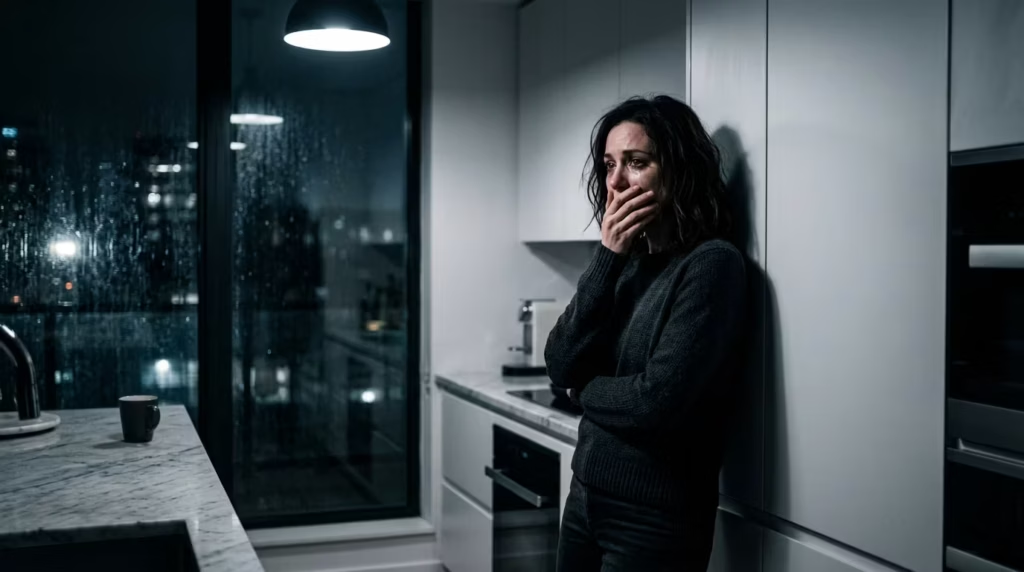
The night Victor Hale struck me, I was holding a dish towel and thinking about nothing at all — just the hiss of the radiator, the rain threading down the floor-to-ceiling windows, the faint smell of garlic still clinging to the kitchen. I had cooked dinner for two. It was past midnight. The food had long gone cold.
He came in smelling of whiskey and someone else’s perfume, and when I asked where he’d been — not accusingly, not even with much feeling, the way you ask about weather — he crossed the marble floor in two strides and hit me so hard the room turned white.
I remember the cold of the floor against my cheek. I remember the blood. I remember Victor looking down at me with something less than contempt, something that barely registered I was there at all.
“Don’t question me like you’re my wife,” he said.
Then the door closed, and I was alone.
I lay there longer than I should have. Not from injury, though my ribs ached when I breathed. I stayed because some part of me was still trying to arrange what had just happened into a shape I could understand — still trying to make it fit the story I had told myself about my life, about this place, about what I had earned.
That was when the other thought arrived, quietly, the way the worst thoughts always do.
I hadn’t stolen Natalie’s life.
I had stolen her suffering.
· · ·
Natalie Carter and I had grown up on the same block in Cleveland, in houses that smelled of mildew and overdue bills. We were the kind of close that forms in childhood when there’s not much else — her mother’s bingo nights, my father’s long silences, the two of us spending summers on her porch eating Popsicles and making promises neither of us knew how to keep. If one of us ever got out, we swore, we’d remember the other.
Natalie got out first.
I stood beside her at the altar in a pale blue dress, holding her bouquet while she married Victor Hale, and I smiled every time a camera flashed. The reception was at a lakeside estate with a string quartet and champagne that cost more than our mothers made in a month. I danced and laughed and said everything a maid of honor is supposed to say.
And I went home and cried, though I told myself it was happiness.
That jealousy didn’t announce itself. It moved in gradually, rearranging things. By the time I hired the private investigator — an impulse I dressed up as concern for my friend — I already knew, somewhere beneath the story I was building, what I was really hoping to find. And I found it: Victor, with another woman, at a hotel in the West Loop. Photographs. Receipts.
I should have driven to Natalie’s house that same evening. I had the address. I had her number memorized. Instead I called the hotel bar and asked if Victor Hale had a standing reservation.
He did.
We met on a Tuesday. He was charming in the blunt, certain way of men who’ve never been told no by anyone they respected. He looked at me the way no one ever had — like I was worth the attention. I understood, even then, that he was looking at me because I was Natalie’s. That was part of the appeal, for both of us, though I couldn’t have admitted it.
Six weeks later I had a townhouse with marble counters and furniture I was afraid to touch.
I told myself I had finally arrived somewhere.
· · ·
After that first night on the kitchen floor, I learned what cycle looked like up close.
Victor came the next morning with roses — peonies, actually, because he’d noticed I preferred them, which somehow made it worse. He set an Hermès box on the counter and said it would never happen again. He said it with such stillness, such apparent sincerity, that I caught myself nodding before I’d decided to believe him.
Because the alternative required me to look at everything else.
So I stayed. And the weeks arranged themselves into a pattern: silence, then warmth, then something small — a question asked too directly, a meal that wasn’t ready — and then the cold behind his eyes and the particular way a room could change when he entered it. A bruise on my arm that I explained to no one because there was no one to explain it to. The townhouse I’d thought of as a gift slowly revealing itself as something else entirely: a private location, a controlled environment, a place where no one would come looking.
I got very good at measuring the temperature of rooms.
· · ·
On a rainy Tuesday afternoon in March, Victor’s phone rang on the kitchen counter while he was in the shower.
Natalie’s name on the screen.
I stood there for three full rings, my hand not moving, something cold spreading through my chest. Then I answered it, because I think some part of me had been waiting for exactly this — not hoping for it, but knowing it was coming, the way you sense the end of something before it arrives.
“Hello?” My voice came out smaller than I meant it to.
A pause. Then: “Lillian?” She sounded confused, not angry. Not yet. “Why do you have Victor’s phone?”
I opened my mouth and closed it.
Victor came into the kitchen with a towel around his waist and took in the scene in an instant — my face, the phone, the name on the screen. Something in his expression went very flat.
“Give me that.”
When I didn’t move, he grabbed my wrist. I heard myself cry out, a short involuntary sound, and then the phone was on the floor and Natalie’s voice was still coming through the speaker, saying hello, hello, while Victor slammed me against the cabinets and leaned in close enough that I could smell the soap on him.
“Do you have any idea,” he said quietly, “what you’ve done.”
It wasn’t a question.
That night he didn’t bring flowers afterward.
Later, lying still on the floor because stillness hurt less than moving, I thought about something I’d filed away without understanding: photographs I’d glimpsed on Victor’s desk once, Natalie stepping out of a car with oversized sunglasses on a cloudy day. The way she turned her face at certain angles. The way she laughed at parties — always half a beat behind, always checking.
I had thought she was being elegant. Reserved. Natalie had always carried herself that way, I’d told myself. It was one of the things I’d envied.
I understood it now.
Victor hadn’t changed when he met me.
I was simply the second woman he’d decided to keep.
· · ·
By five in the morning I had a backpack with clothes, cash, and my passport. I didn’t take the watch or the coat or anything from the jewelry box. I left the key on the counter and walked out into a cold Chicago morning and kept walking until I found a bus.
I spent three months in a small town in Michigan, in an apartment above a laundromat, working the early shift at a diner that smelled of coffee and maple syrup. I shortened my name to Lily and told people I was from Columbus and let the quiet rebuild me, piece by piece. No shouting. No checking the door. Some mornings I’d finish a shift and stand outside in the cold and just breathe, aware of nothing except that no one was watching.
I thought I might be safe.
Then I started noticing the black SUV.
It appeared on a Monday, idling across from the diner. Gone by the time I came out. Back again an hour later. After that I stopped sleeping well, and started sitting with my back to the wall, and noted every car in the lot before I entered a room.
A week later, a private message arrived on the diner’s Facebook page, from an account with no photo.
I know this is you. We need to talk before he finds you.
· · ·
We met at a park near Lake Michigan on a Thursday afternoon, gray sky, wind off the water, the kind of cold that gets into your shoulders. Natalie was thinner than I remembered, and she moved carefully, the way people move when something has been hurting them a long time.
We sat on a bench and didn’t speak for a while.
“I should hate you,” she said finally.
“I know.”
She watched a gull drag something across the sand. “It’s hard to hate someone when you realize you were both trapped by the same person.”
She told me what those years had looked like from inside the mansion. Behind the charity galas and the designer shoes and the magazine photographs of the two of them at fundraisers — behind all of it, the same pattern I recognized. She’d been collecting evidence for eight months. Medical records. Security footage. Text messages. She had a lawyer. She had a plan. She needed one more thing.
“He’s been looking for you,” she said. “And he won’t stop.”
I started to answer, and then a black sedan came slowly around the corner of the lot.
Victor stepped out.
But Natalie was already on her phone.
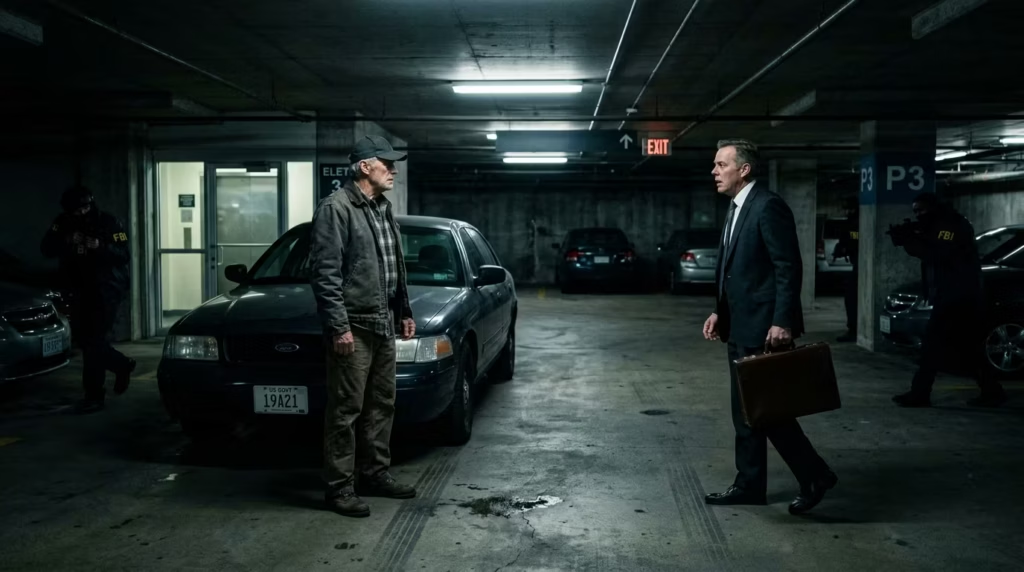
The federal agents arrived in three cars. I watched Victor stop walking and look around him with the expression of a man recalculating, and then the calculation ran out, and they took him.
· · ·
The investigation took fourteen months. Other women came forward — women I didn’t know, from cities I’d never been to, with the same photographs and the same story told in different rooms. I gave my testimony and didn’t omit anything, including the parts that made me look exactly like what I was: a woman who had known the truth and chosen convenience instead.
Victor Hale was sentenced to nine years.
Natalie filed for divorce the same week the verdict came down. We are not what we were — we may never be — but we have spoken on the phone, carefully, the way you speak to someone when you’re still deciding what to trust. It is not nothing.
I live differently now. Smaller, quieter, more honest about the cost of wanting what belongs to someone else. Some mornings I still catch myself measuring rooms when I enter them — old habit, fading slowly.
What I don’t do anymore is mistake the outside of something for the whole of it. A life can look like an answer from far enough away. Up close, it shows you what it actually is.
I know that now.
I learned it on a kitchen floor.